IN BRIEF
- Madagascar is the world’s fourth-largest island, about 400 km (250 miles) off Africa.
- 82% of its native vascular plants and 90% of its land and freshwater vertebrates are endemic (Kew, 2022).
- 103 of its 107 lemur species are threatened, per the IUCN’s 2020 Red List.
- The oldest traces of people date back over 10,500 years, a debated figure.
Quiz
Do you know Madagascar?
How does Madagascar rank among the world’s largest islands?
Every answer comes from the sources cited in this article (including IUCN, Nature, Kew, UNESCO, FAO data, ETH Zurich, US Library of Congress), as checked in October 2026. New studies can change these figures.
These 25 facts about Madagascar come with their sources, because many online lists repeat wrong figures. From our home on Sainte-Marie, we lean on scientific papers and official records for most numbers below.
The headline facts hold up: most of Madagascar’s wildlife lives nowhere else, and its people’s African and Asian roots mixed within the last millennium.
Madagascar at a glance: key figures
Madagascar is an island republic whose capital is Antananarivo and whose currency is the ariary.
1. Madagascar is the fourth-largest island on Earth, according to SADC and the University of Hamburg island database. It lies about 400 km (250 miles) off Africa. The World Bank’s country page says fifth instead.
2. Madagascar had 32,740,678 people in 2025, per the World Bank, against 25,674,196 at the 2018 census (Hamburg island database). The population grows about 2.4% a year.
3. The Constitution describes the flag precisely: a white vertical band on the hoist side, then red above green. It also makes Malagasy and French the official languages.
| Key figure | Madagascar | Source |
|---|---|---|
| Capital | Antananarivo | Constitution (2010) |
| Area | 587,041 to 587,295 km² (about 226,700 sq mi) | University of Hamburg; SADC |
| Length and width | 1,580 km by 600 km (980 by 370 miles) | SADC |
| Coastline | About 5,000 km (3,100 miles) | SADC |
| Highest point | Maromokotro, 2,876 m (9,436 ft) | University of Hamburg |
| Population | 32,740,678 (2025) | World Bank |
| Population growth | About 2.4% a year | World Bank |
| Languages | Malagasy (national); Malagasy and French (official) | Constitution (2010) |
| Currency | Malagasy ariary (MGA) | SADC |
| Independence day | June 26, 1960 | SADC |
| National motto | Fitiavana – Tanindrazana – Fandrosoana | Constitution (2010) |
| National anthem | Ry Tanindrazanay malala ô! | Constitution (2010) |
| Head of state | Col. Michael Randrianirina | SADC |
| Time zone | GMT+3, no daylight saving | Kokoa Serena travel guide |
| Poverty | 66.5% of the population (2025 estimate) | World Bank |
Wildlife facts: an island of endemic species
Isolation made most of Madagascar’s species unique, and many of them are now threatened with extinction.
4. 82% of native vascular plants are endemic, per a 2022 Kew-led review of 11,516 described species. Among 1,314 native land and freshwater vertebrates, the rate reaches 90%.
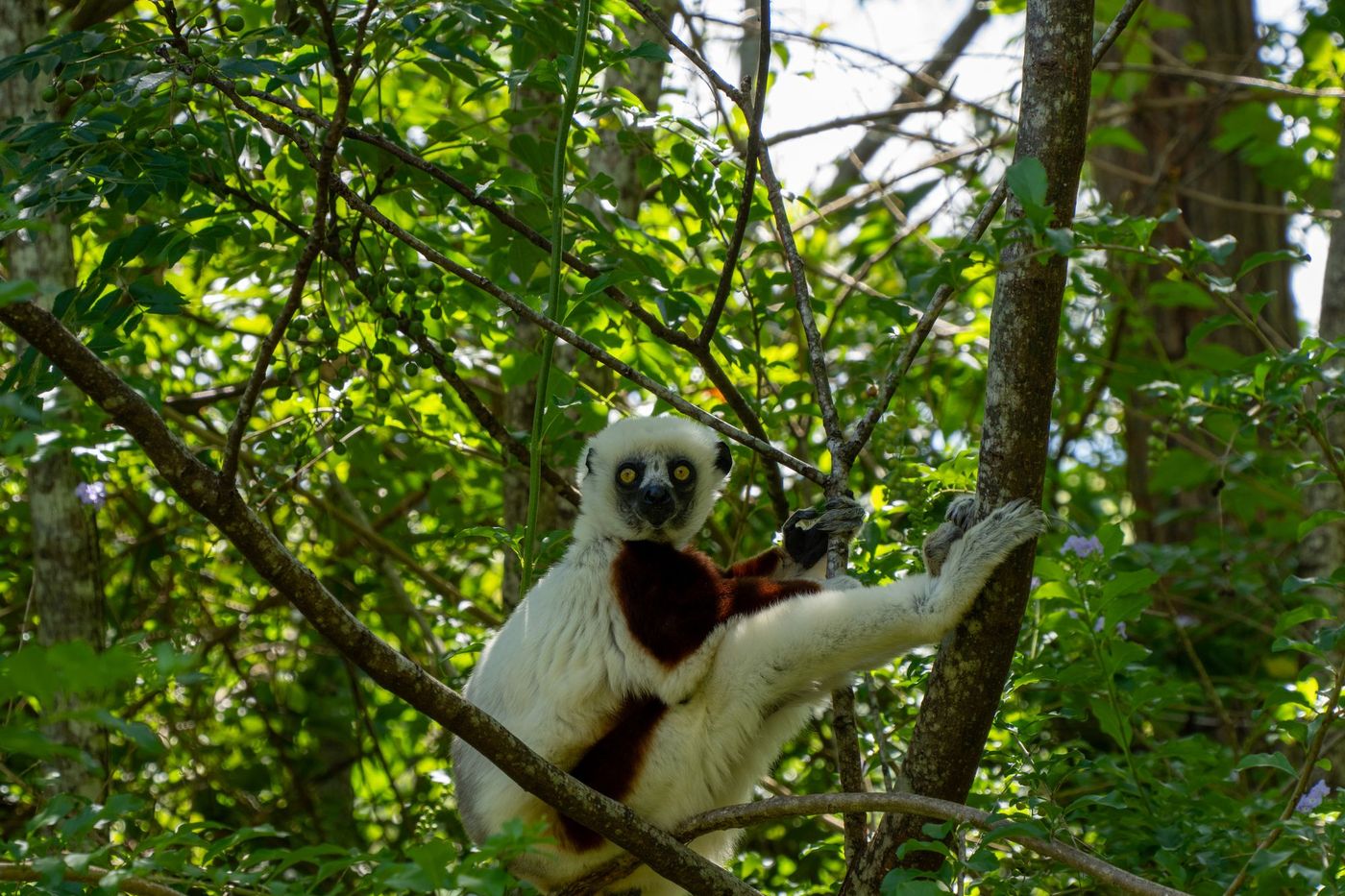
5. Lemurs are the most endangered mammal group, says the Lemur Conservation Network, and every species is endemic. The IUCN Red List counted 107 species in July 2020: 103 threatened and 33 Critically Endangered, mainly through deforestation and hunting. The group includes Madame Berthe’s mouse lemur, the world’s smallest primate.
6. Six of the world’s eight baobab species grow only in Madagascar, according to a 2024 study in Nature. The other two grow in mainland Africa and northwestern Australia, and the authors argue today’s baobabs originated in Madagascar.
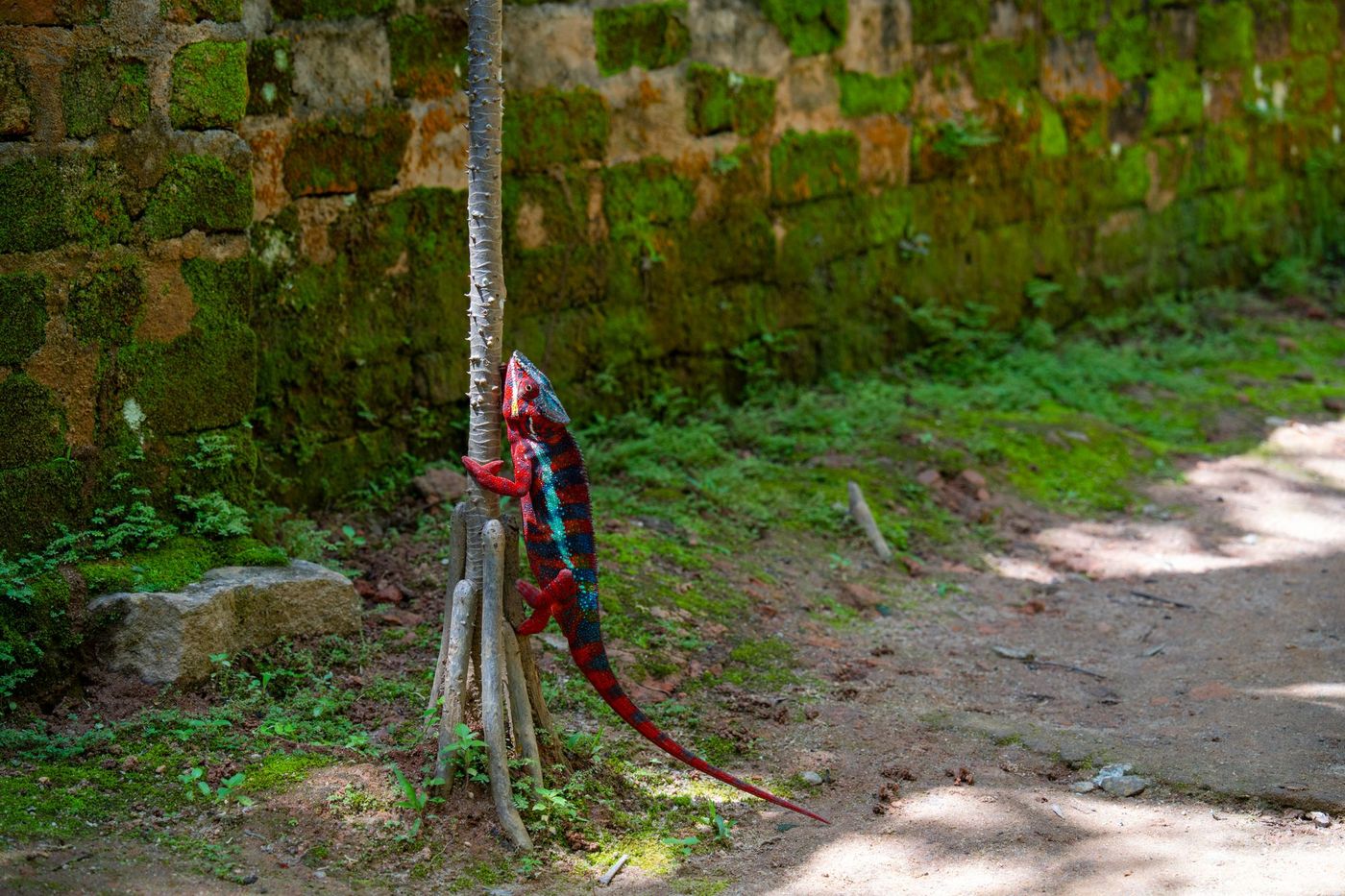
7. Nearly half of all chameleon species live only in Madagascar: 85 species, per the 2014 IUCN assessment reported by Mongabay. One of them, Brookesia nana, may be the smallest reptile on Earth: the male measures 21.6 mm (0.85 in) with its tail (Scientific Reports, 2021).
8. The largest bird that ever lived came from Madagascar. The extinct elephant bird Vorombe titan averaged almost 650 kg (about 1,430 lb), according to a study by Hansford and Turvey.
9. Two cancer drugs come from the Madagascar periwinkle, a small native plant. Vinblastine and vincristine, developed from its extract, won US FDA approval in the 1960s (John Innes Centre).
GOOD TO KNOW
The “90% endemic” figure holds for land and freshwater vertebrates together, not for every living thing. Rates vary widely by group, from 100% for primates and 99% for amphibians to 52% for birds (Goodman, Oryx 2022). Vascular plants reach 82%, after over 160 million years of mostly isolated evolution (Science, 2022).
Interesting facts about the island’s geography
Madagascar is an old island with a high central plateau and red soils, edged by a narrow coastal plain.
10. Madagascar split from Africa first, about 170 million years ago, per ETH Zurich (Science Advances, 2025). A second rift, around 90 million years ago, cut it off from India and the Seychelles. Volcanic rocks date that break to 87.6 million years ago (Science, 1995).
11. Its nickname is the “Great Red Island”, after the red lateritic soils that dominate the central highlands, notes the US Library of Congress country study.
12. The highest summit reaches 2,876 m (9,436 ft) at Maromokotro, in the northern Tsaratanana Massif, per the University of Hamburg. The Library of Congress gives 2,880 m (9,449 ft).
13. A forest of limestone needles rises in western Madagascar. It sits within UNESCO’s Andrefana Dry Forests site, listed in 1990 as the Tsingy de Bemaraha reserve and extended in 2023. It ranks among the best sites to visit in Madagascar.
14. At most 15% of the natural forest that stood before human colonization survives, under 10% by some analyses (Oryx, 2022).
Fun facts about Madagascar the country and its people
Some of the most interesting facts of Madagascar concern its people. Their language and genes link Africa with Southeast Asia, across the Indian Ocean.
15. Malagasy’s closest relative is Ma’anyan, spoken in southeast Borneo. The Library of Congress adds that Malagasy is the only Malayo-Polynesian language in the African region. Yet its names for days and months come from Arabic, and many animal names from a Swahili dialect.
16. Malagasy people share African and Asian ancestry, according to a 2017 genetic study in PNAS: Bantu and Austronesian roots, mixed within the last millennium. A 2016 study traces the Asian side to the Banjar of southeast Borneo. Scholars count eighteen or twenty ethnic groups, and our Madagascar culture guide explains their local taboos.
17. Independence from France came in 1960, and the BBC tracks the political crises that have recurred since. In October 2025, after youth-led “Gen Z Madagascar” protests, the army took power (Al Jazeera). Colonel Michael Randrianirina, listed by SADC as head of state, promised elections in two years.
History facts: pirates, a queen and late settlers
Madagascar’s past mixes pirate bases, a queen wary of foreigners and a debated date for the first settlers.
18. The first humans may have arrived more than 10,500 years ago, judging by elephant-bird bones with human cut marks (Science Advances, 2018). Earlier research put the first arrivals around 2,500 years ago.
19. Queen Ranavalona I ruled from 1828 to 1861, distrusting foreign influence, per the Library of Congress. Protestant converts were persecuted and killed, and after she banned Christianity in 1835, nearly all foreigners left within a year (Wikipedia). Missionaries had already written Malagasy in the Latin alphabet, and several thousand people could read by 1828.
20. Sainte-Marie, our island, was a pirate base from Adam Baldridge in 1691 to John Pro in 1719, according to Wikipedia. Pirates watched for ships from the Baie des Forbans, and in 1750 the Betsimisaraka ruler Bety ceded the island to France.
IMPORTANT
Three popular claims fail once checked against the sources.
- “Madagascar grows 80% of the world’s vanilla” does not match FAO data: about 3,000 of roughly 8,000 metric tons a year in 2010–2019. It remains the leading exporter.
- The 2015 “Kidd treasure” off Sainte-Marie was not silver. UNESCO experts found a ballast bar, 95% lead, and the “wreck” was part of the port.
- “Madagascar split from Africa 88 million years ago” mixes two events: Africa about 170 million years ago, India around 88 to 90 million.
Everyday life: vanilla, rice and zebu
Rice anchors nearly every Malagasy meal, while vanilla carries the island’s name around the world.
21. Vanilla is not native to Madagascar, even though the island is the top vanilla exporter. The main species comes from Middle America, notes a scientific review, and Edmond Albius of Réunion made hand pollination practical around 1841. In 2023, Madagascar exported US$271.7 million of vanilla, against US$52.3 million for runner-up France (WITS).
22. Malagasy people eat about 300 g (10.6 oz) of dry rice per person per day, more than nearly any other country. The figure comes from a 2019 study in Public Health Nutrition, the only open source we found.
Rice, roots and tubers make up nearly 80% of the diet by weight, the same study adds. Romazava, a beef and greens stew served over rice, is the national dish; our page on food in Madagascar covers the rest.
23. About 99% of Madagascar’s cattle are zebu, per the Library of Congress country study. The newest herd figure on record, 10.3 million cattle, is an FAO estimate from 1990.
10 interesting facts about Madagascar for kids
Many of Madagascar’s animals live nowhere else on Earth. Each line retells a numbered fact simply.
- Madagascar is a giant island, the fourth-biggest on Earth (fact 1).
- Its flag is white, red and green, with white next to the flagpole (fact 3).
- Lemurs live only in Madagascar, and the tiniest is the smallest primate on Earth (fact 5).
- Six kinds of baobab trees grow nowhere else (fact 6).
- One chameleon, Brookesia nana, is just over 2 cm (0.85 in) long with its tail (fact 7).
- The biggest bird that ever lived weighed almost 650 kg (1,430 lb) and lived here (fact 8).
- A small plant called the periwinkle helped make two cancer medicines (fact 9).
- The soil is red in the highlands, hence the name Great Red Island (fact 11).
- People speak Malagasy, whose closest cousin language is spoken in faraway Borneo (fact 15).
- Humpback whales swim nearly 6,000 km (3,700 miles) to reach Sainte-Marie (fact 24).
Facts you can check for yourself on a trip
Several of these facts can be seen on Sainte-Marie, the island where we live.
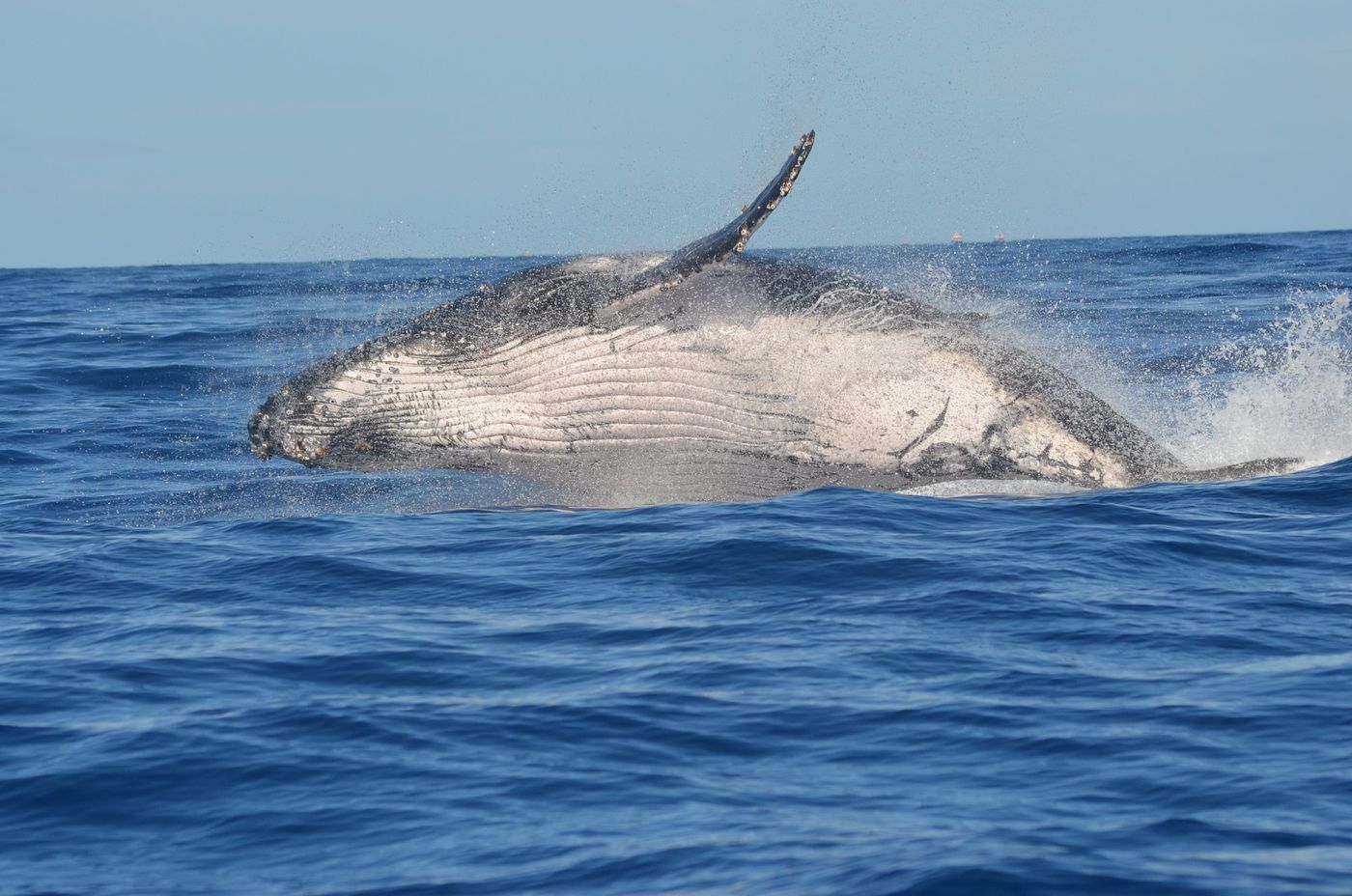
24. Humpback whales swim nearly 6,000 km (3,700 miles) from Antarctic waters to the channel off Sainte-Marie. Some 2,000 to 3,000 are present each season, from mid-June to late September, peaking late July to mid-August. Boats keep at least 100 m (330 ft) away, for 30 minutes at most. Sainte-Marie’s humpback whale season gets its own page.
25. Madagascar’s first stone Catholic church stands in Ambodifotatra (or Ambodifototra), Sainte-Marie’s harbor town, facing Îlot Madame. Built of dressed stone and granite rubble, it is 35 m (115 ft) long and 12 m (39 ft) high, per UNESCO. It has been on Madagascar’s UNESCO Tentative List since 2018.
Other sights tie in with these facts, on our island or elsewhere in Madagascar:
- The pirate cemetery on Sainte-Marie holds 17th- and 18th-century graves above the bay (fact 20).
- Historic wrecks do lie in Sainte-Marie’s bays, UNESCO confirmed.
- The Ambodiforaha forest shelters chameleons, lemurs and endemic orchids (facts 5 and 7).
- The west holds baobabs and tsingy, two classics among our things to do in Madagascar (facts 6 and 13).
- The indri, the largest living lemur, calls through the rainforest at Andasibe.
EXPERT TIP
- Aim for early September for whales, with calves born and fewer crowds.
- Travel in the dry season, May to October; the tsingy close in the heaviest rains.
- A guided half-day hike is enough for the Ambodiforaha forest.
- Pick two regions in ten to fourteen days; our guide on when to visit Madagascar goes month by month.
Other questions about Madagascar
Most have clear answers, but snow records and settlement dates remain uncertain.
Has it ever snowed in Madagascar?
Reportedly, but no dated official record turned up in our research. The One Earth/WWF ecoregion profile says snow has been recorded on the Andringitra Massif, without a date. Lows there can reach 12°F (−11°C), and Madagascar National Parks reports temperatures well below freezing from April to September.
How many species are unique to Madagascar?
No single total covers every living thing. The 2022 Science review gives shares by group instead, such as 82% of 11,516 native vascular plants and 28% of 1,215 bryophytes. For land and freshwater vertebrates, Kew gives 90% of 1,314 species.
When was Madagascar first settled?
Perhaps as early as 11,000 years ago, though the debate stays open. A 2019 Penn State review of radiocarbon dates supports that figure, against older estimates of 2,000 to 2,500 years. Whether those first people stayed is unknown.
What is Madagascar best known for?
Its wildlife tops most lists, from lemurs to baobabs. It is also known for three UNESCO World Heritage sites and for vanilla. In July 2025, UNESCO took the Rainforests of the Atsinanana off its in-danger list.
KEY TAKEAWAYS
- Madagascar is the fourth-largest island, with 32.7 million people in 2025.
- Endemism varies: 82% for vascular plants, 90% for vertebrates, 52% for birds.
- Lemurs, 107 species in 2020, are the most endangered mammal group.
- Ignore the “80% of world vanilla”, “Kidd treasure” and “88 million years from Africa” claims.
- On Sainte-Marie, whales, pirate graves and a stone church are facts you can see.